




Every Founder Starts by Saying, “I Want to Build the Next Amazon.”
It usually begins with a simple ambition.
- A retailer wants to sell more products online
- A manufacturer wants to reach customers directly
- A startup founder notices a niche with fragmented suppliers
- An entrepreneur spots an underserved local market
Soon, the idea evolves:
“What if I built my own Amazon?”
On the surface, it sounds logical. Amazon dominates ecommerce, processes billions of orders every year, and has fundamentally changed how people shop. If you’re building an online business, why not follow the company that seems to have already figured everything out?
But here’s the uncomfortable truth:
Amazon isn’t successful because it’s an online store. It’s successful because it’s an ecosystem.
That’s an important distinction, and one many founders overlook.
When most people imagine Amazon, they picture millions of products, lightning-fast delivery, competitive pricing, and endless categories. What they don’t immediately see is the infrastructure behind it: millions of independent sellers, third-party logistics partners, advertisers, software providers, fulfillment networks, payment systems, cloud services, subscription programs, and recommendation engines all working together.
In other words, Amazon’s greatest competitive advantage isn’t its inventory.
It’s the network it has built.
Unfortunately, many entrepreneurs spend months, or years, trying to replicate Amazon’s storefront without understanding the marketplace model that powers it.
They invest heavily in inventory, warehouses, marketing campaigns, customer support, and fulfillment. Every new product requires capital. Every expansion into a new category increases operational complexity. Growth becomes expensive long before it becomes profitable.
The irony is that the businesses experiencing the fastest growth today aren’t trying to become another Amazon.
They’re building marketplaces.
Whether it’s B2B procurement platforms, local service marketplaces, rental platforms, franchise ecosystems, wholesale networks, booking platforms, or creator-driven commerce, successful founders are shifting from owning every transaction to enabling thousands of others to participate.
That shift changes everything.
Retailers Ask
“How can I sell more products?”
Marketplace Founders Ask
“How can I create more opportunities for buyers and sellers to transact?”
It’s a fundamentally different way of thinking, and it’s one that’s redefining ecommerce in 2026.
The Biggest Misconception About Amazon
Here’s one of the most common pieces of advice circulating in entrepreneurship communities:
“Build an Amazon for your niche.”
It sounds inspiring.
It’s also incomplete.
Amazon’s success wasn’t built by copying another retailer. It came from solving increasingly complex problems that traditional retail couldn’t solve at scale.
It started as an online bookstore. Then it expanded into categories. Then it invited third-party sellers. Then it launched fulfillment services. Then cloud computing. Then advertising. Then subscriptions. Then AI-powered recommendations. Then logistics infrastructure.
Amazon evolved into an operating system for commerce, not just a digital storefront.
Yet many founders focus only on what customers see: the homepage, product listings, and checkout experience.
They rarely think about the invisible systems that make the business scalable:
- Seller onboarding
- Vendor management
- Commission structures
- Payment distribution
- Catalog governance
- Product moderation
- Shared inventory
- Customer trust
- Marketplace analytics
- Operational automation
Those are marketplace capabilities, not traditional ecommerce features.
Trying to imitate Amazon by building a large online store often leads to an expensive lesson: a bigger catalog doesn’t automatically create a better business.
What matters is how efficiently that catalog grows, who contributes to it, and whether your platform becomes more valuable as more participants join.
That’s the essence of a marketplace.
Why Copying Amazon Is the Wrong Goal
One of the biggest strategic mistakes founders make is assuming that success comes from selling everything.
In reality, successful marketplaces often succeed by serving someone extremely well.
Think about the platforms people use every day.
People don’t visit Airbnb because it sells the most products. They use it because it connects travelers with unique accommodations.
They don’t choose Fiverr because it owns creative agencies. It enables freelancers and businesses to work together.
They don’t rely on Uber because Uber owns millions of cars. It orchestrates a network of drivers and riders.
These companies solved coordination problems, not inventory problems.
That’s a subtle but powerful difference.
Entrepreneurs Ask
“How many products can I stock?”
Marketplace Operators Ask
“How many businesses can I empower?”
This mindset dramatically changes how you think about growth.
Instead of spending more money every time you expand your catalog, you create systems that encourage vendors to expand it themselves. Instead of negotiating every supplier relationship personally, you develop onboarding processes that attract quality sellers. Instead of managing every product update manually, you automate catalog contributions and governance.
Growth becomes collaborative rather than centralized.
That’s one reason marketplaces often scale more efficiently than traditional ecommerce businesses.
Traditional Ecommerce Has Invisible Limits
Launching an online store has never been easier.
Modern ecommerce platforms allow almost anyone to start selling within days.
But growing beyond a certain point introduces challenges that technology alone cannot solve.
These limitations aren’t obvious in the early stages. They emerge as the business scales.
Inventory Becomes a Financial Burden
Every new product represents tied-up capital. Every warehouse shelf holds money that could have been invested elsewhere.
Demand forecasting becomes increasingly difficult. A single forecasting mistake can leave you with excess inventory, or worse, stockouts that disappoint customers.
Scaling means buying more before you’ve sold more. That creates financial pressure that compounds over time.
Expansion Requires Constant Capital
Want to enter a new category? You need suppliers. You need purchasing agreements. You need inventory. You need warehousing. You need photography. You need marketing. You need customer support.
Every expansion starts with another investment.
Marketplaces approach expansion differently. Instead of purchasing products themselves, they invite experts who already sell them. Growth becomes an onboarding challenge rather than an inventory challenge.
Operations Become Increasingly Complex
As catalogs expand, so do operational headaches. More suppliers. More stock updates. More returns. More shipping rules. More customer inquiries. More pricing decisions.
Eventually, operational complexity grows faster than revenue. Many founders discover they’re spending more time managing internal processes than serving customers.
Product Variety Eventually Slows Down
Traditional retailers often struggle to introduce niche products. Why? Because stocking slow-moving inventory is risky.
Yet niche products frequently create loyal customers.
Marketplace models allow those products to exist without forcing the platform to own them. That’s why marketplaces naturally support broader product diversity.
Why Inventory-Heavy Businesses Eventually Hit a Wall
Inventory isn’t inherently bad.
Many successful retailers rely on it.
But inventory changes the economics of growth.
Every product you own introduces multiple responsibilities:
- Purchasing
- Storage
- Insurance
- Fulfillment
- Returns
- Depreciation
- Inventory forecasting
- Demand planning
As your catalog grows, these responsibilities multiply.
Margins become increasingly vulnerable to errors. Products become obsolete. Seasonal demand shifts. Warehousing costs rise. Cash flow tightens.
This doesn’t mean inventory-based businesses can’t succeed.
It means they scale differently.
Marketplace businesses often scale by enabling transactions rather than owning assets.
That distinction creates remarkable flexibility.
A marketplace can expand into entirely new categories without purchasing thousands of new products.
Instead, it invests in attracting the right sellers, improving discovery, maintaining trust, and simplifying transactions.
Its primary asset isn’t inventory.
It’s participation.
Customer Expectations Have Changed Faster Than Most Businesses
Consumer expectations in 2026 look very different from what they were just a few years ago.
People no longer compare your business only to competitors.
They compare every online experience to the best experience they’ve ever had.
They expect:
- Extensive product choice
- Fast delivery
- Transparent pricing
- Reliable reviews
- Personalized recommendations
- Flexible payment methods
- Seamless mobile experiences
- Real-time availability
- Responsive support
Meeting all these expectations as a single retailer becomes increasingly difficult.
Marketplace businesses distribute these responsibilities across an ecosystem of sellers while maintaining a consistent customer experience.
This doesn’t remove operational responsibility, it changes where value is created.
Instead of focusing exclusively on selling products, marketplace operators focus on designing better interactions between buyers, sellers, logistics partners, and service providers.
Increasingly, AI is enhancing these interactions by improving search relevance, automating product categorization, identifying fraudulent behavior, forecasting demand, and personalizing recommendations.
The most competitive marketplaces are using AI not to replace people, but to make every participant in the ecosystem more effective.
The Rise of Ecosystem Businesses
One of the biggest business shifts of the past decade has been the move from companies that own everything to companies that orchestrate everything.
Rather than trying to control every part of the value chain, modern platforms create environments where multiple businesses can succeed together.
This model has expanded far beyond ecommerce.
- Manufacturers are launching dealer marketplaces
- Franchise brands are creating digital ecosystems for every location
- Wholesale businesses are connecting suppliers and buyers through shared catalogs
- Healthcare providers are building networks of specialists
- Educational companies are connecting instructors with learners
- Service providers are enabling professionals to reach customers through a single trusted platform
- Even traditional retailers are introducing third-party sellers to increase selection without dramatically increasing inventory
The value no longer comes solely from what the company owns.
It comes from what the company enables.
This is why the role of a marketplace operator increasingly resembles that of an ecosystem architect. Success depends less on managing every product and more on creating the rules, tools, and incentives that allow participants to thrive together.
As these ecosystems mature, operators also need technology that can support multiple stores, different commission structures, vendor onboarding, compliance, analytics, distributed fulfillment, and collaborative workflows.
Where MultiVendorX Fits Naturally
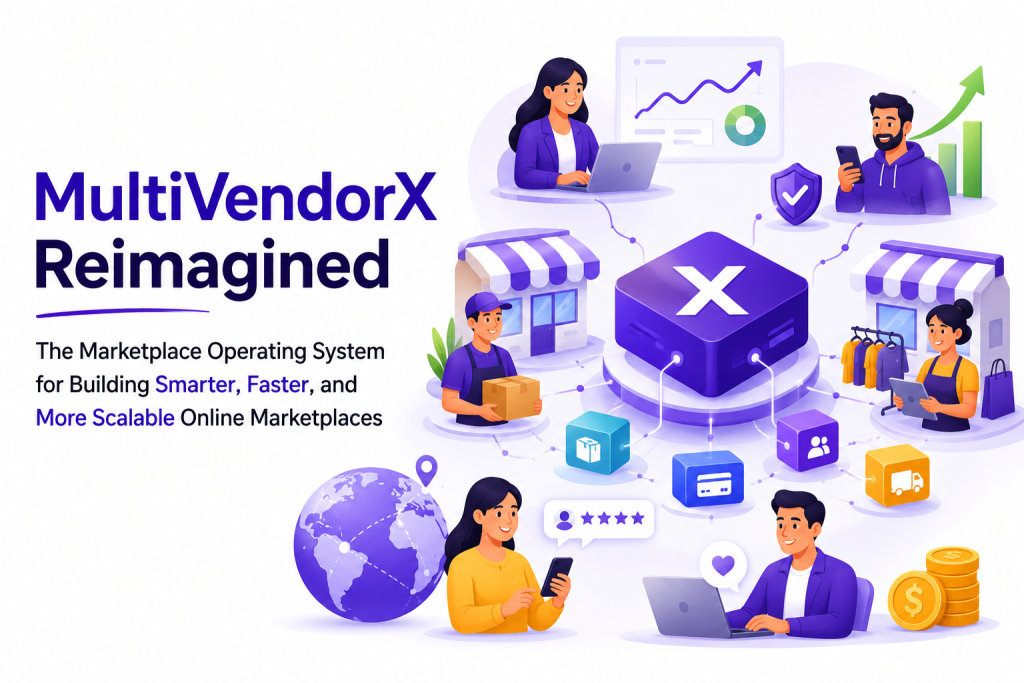
This is where a Marketplace Operating System becomes more valuable than a simple multi-vendor plugin. Platforms like MultiVendorX are designed to provide that operational foundation, helping marketplace owners automate complex processes and scale without multiplying administrative overhead.
Marketplace Economics Explained
So what makes marketplaces economically different?
The answer lies in how value is created.
Traditional ecommerce grows by increasing internal capacity.
Need more revenue? Buy more inventory. Hire more employees. Expand warehouses. Increase logistics.
Growth depends heavily on adding more resources.
Marketplace businesses follow a different pattern.
Revenue grows as more buyers and sellers participate in the ecosystem.
Every successful vendor adds products, attracts customers, and expands the platform’s value without requiring the operator to purchase additional inventory.
This creates what economists call network effects: as participation increases, the marketplace becomes more useful to everyone involved.
More sellers attract more buyers because customers have greater choice. More buyers attract more sellers because vendors gain access to larger audiences.
This positive feedback loop can accelerate growth in ways that are difficult for traditional ecommerce businesses to replicate.
Marketplace operators also benefit from diversified revenue opportunities. Beyond product sales, they can monetize commissions, subscriptions, premium storefronts, featured listings, advertising, fulfillment services, financial services, and value-added tools for vendors.
Revenue becomes tied to the health of the ecosystem rather than the success of a single product line.
That doesn’t mean marketplaces are easier to build. They require trust, governance, balanced supply and demand, and strong operational systems. But when designed well, they can scale with greater capital efficiency and resilience than inventory-heavy retail models.
The goal is no longer to become the biggest online store.
It’s to become the platform that makes commerce easier for everyone else.
And that’s the strategic shift more founders are beginning to embrace.
10 Problems Traditional Ecommerce Can’t Solve (But Marketplaces Can)
By now, one thing should be clear: this isn’t a debate about whether traditional ecommerce works. It does, and for many businesses, it remains the right model.
If you’re selling your own products, controlling manufacturing, or building a direct-to-consumer (DTC) brand, a single-store ecommerce model can be incredibly successful.
The challenge begins when growth depends on adding more products, reaching new markets, serving different customer segments, or expanding into entirely new categories. That’s when the limitations of owning everything become increasingly apparent.
Marketplace businesses approach growth differently. Instead of trying to do more themselves, they create systems that allow many businesses to grow together.
Let’s explore ten challenges where marketplace models consistently outperform traditional ecommerce, and why more founders are making this strategic shift.
Problem 01
Limited Product Selection
The Ecommerce Limitation
Every new product in a traditional online store comes with a decision. Should you stock it? How much inventory should you buy? Will customers actually purchase it? Can you justify the warehouse space?
These questions naturally limit how quickly retailers expand their catalogs. Even large ecommerce brands hesitate before introducing niche products because every new SKU carries financial and operational risk.
As a result, customers often encounter limited selection, especially in specialized industries where preferences vary widely.
The Marketplace Solution
Marketplaces remove this bottleneck by allowing independent vendors to contribute products directly.
Instead of one business deciding what deserves shelf space, dozens, or even thousands, of sellers expand the catalog organically.
The platform grows because vendors grow. This creates a catalog that reflects actual market demand rather than a retailer’s purchasing decisions.
Real-World Example
Etsy didn’t become the world’s leading handmade marketplace by manufacturing crafts. It empowered millions of independent creators to bring their own products to customers worldwide. Each new seller expanded the platform’s value without Etsy investing in inventory. The same principle applies to industrial marketplaces, wholesale platforms, automotive parts marketplaces, and specialty food marketplaces.
Business Outcome
- Faster catalog expansion
- Greater product diversity
- Improved customer retention
- Better search relevance
- More long-tail sales opportunities
How MultiVendorX Helps
A Marketplace Operating System should make vendor onboarding and product publishing frictionless. MultiVendorX enables marketplace operators to approve vendors, manage product workflows, organize catalogs, and support multiple stores, all without requiring the platform owner to manually manage every listing. The result is sustainable catalog growth driven by your vendor ecosystem rather than your purchasing budget.
Problem 02
Inventory Risk
The Ecommerce Limitation
Inventory is often the biggest financial burden in retail. Overestimate demand and your cash sits on warehouse shelves. Underestimate demand and customers leave disappointed.
As businesses scale, forecasting becomes increasingly difficult because demand fluctuates across seasons, regions, and product categories. Growth requires larger inventory investments long before additional revenue arrives.
The Marketplace Solution
Marketplace operators focus less on owning inventory and more on facilitating transactions. Vendors manage their own stock while the platform provides visibility, trust, and customer acquisition.
Risk becomes distributed instead of centralized. Instead of one business carrying the financial burden, hundreds of vendors each manage inventory aligned with their expertise.
Real-World Example
Amazon Marketplace transformed Amazon from a retailer into a platform where millions of sellers manage their own inventory while Amazon provides infrastructure, logistics, and customer reach. The marketplace model dramatically expanded selection without requiring Amazon Retail to purchase every product itself.
Business Outcome
- Lower capital requirements
- Reduced inventory waste
- Better cash flow
- Easier category expansion
- More resilient operations
How MultiVendorX Helps
MultiVendorX supports independent vendor stores, allowing sellers to maintain their own products, pricing, stock, and operations. Marketplace owners can expand offerings without assuming the inventory risk traditionally associated with retail growth.
Problem 03
Slow Expansion Into New Categories
The Ecommerce Limitation
Imagine running an online electronics store. Now you want to add home appliances. That means finding suppliers, negotiating pricing, importing products, photographing inventory, creating descriptions, warehousing products, training support teams, and planning logistics.
Every new category becomes a significant operational project.
The Marketplace Solution
Marketplaces expand through participation rather than procurement. Instead of sourcing products yourself, you invite specialists who already operate in that category.
Growth becomes a matter of attracting the right vendors instead of acquiring more inventory.
Real-World Example
Many B2B procurement marketplaces started by serving one industry before expanding into adjacent sectors by onboarding new suppliers rather than building entirely new supply chains.
Business Outcome
- Faster market expansion
- Lower operational overhead
- Better category expertise
- Improved customer experience
- Reduced launch costs
How MultiVendorX Helps
As your marketplace grows, MultiVendorX enables multiple vendors, stores, and product categories to coexist under a unified platform. Marketplace owners can introduce entirely new business verticals without redesigning their operational structure.
Problem 04
Geographic Limitations
The Ecommerce Limitation
Traditional ecommerce often scales from a central warehouse. As customers become geographically dispersed, delivery costs increase, shipping times lengthen, and regional inventory planning becomes increasingly complex.
For businesses serving local markets, centralized operations simply don’t work.
The Marketplace Solution
Marketplace ecosystems naturally distribute commerce. Local vendors serve local customers. Regional sellers understand regional demand.
Delivery becomes faster because inventory already exists closer to buyers.
Real-World Example
Hyperlocal grocery platforms connect neighborhood stores with nearby customers instead of shipping products across the country. Restaurant delivery platforms follow the same principle. The marketplace connects existing businesses instead of replacing them.
Business Outcome
- Faster fulfillment
- Lower shipping costs
- Better regional availability
- Increased local trust
- Easier international expansion
How MultiVendorX Helps
MultiVendorX supports multi-store operations, making it easier to build regional, franchise, and location-based marketplaces where vendors manage inventory locally while customers enjoy a unified buying experience.
Problem 05
Vendor Innovation Bottlenecks
The Ecommerce Limitation
Innovation slows when every product decision depends on one company. New products require internal approval. Marketing teams must prioritize launches. Merchandising teams decide which ideas move forward.
This centralized model limits experimentation.
The Marketplace Solution
Marketplaces decentralize innovation. Every vendor becomes an entrepreneur. Each seller experiments with pricing, bundles, product ideas, promotions, and merchandising.
Successful innovations emerge naturally. The marketplace benefits from thousands of experiments instead of relying on one internal product team.
Real-World Example
App marketplaces, creator marketplaces, and digital asset marketplaces thrive because contributors constantly introduce new offerings without waiting for platform approval.
Business Outcome
- Faster product innovation
- Continuous catalog improvement
- Greater customer engagement
- Higher vendor satisfaction
How MultiVendorX Helps
Marketplace operators can define governance rules while still allowing vendors to innovate within those boundaries. Approval workflows, moderation tools, and vendor dashboards create a balance between quality control and entrepreneurial freedom.
Problem 06
Supplier Relationships Don’t Scale Well
The Ecommerce Limitation
Retailers often manage hundreds of supplier relationships manually. Every supplier requires negotiations, communication, forecasting, invoicing, and performance monitoring.
As supplier networks grow, operational complexity grows even faster.
The Marketplace Solution
Marketplace businesses replace one-to-one supplier management with scalable onboarding systems. Instead of managing every vendor personally, operators establish standards, automation, and self-service workflows.
Relationships become structured rather than manual.
Real-World Example
Wholesale marketplaces allow thousands of suppliers to join standardized procurement platforms while maintaining their own catalogs and operations.
Business Outcome
- Faster supplier onboarding
- Lower administrative workload
- Better vendor retention
- Easier compliance management
- More scalable operations
How MultiVendorX Helps
Vendor registration, approvals, onboarding workflows, role-based permissions, compliance processes, and automated marketplace operations help reduce administrative effort while improving the vendor experience.
Problem 07
Capital Efficiency
The Ecommerce Limitation
Traditional ecommerce often requires significant upfront investment. Inventory. Warehousing. Packaging. Staff. Equipment. Marketing. Every growth milestone typically demands more capital.
The Marketplace Solution
Marketplace businesses invest primarily in technology, trust, and ecosystem growth. Rather than purchasing inventory, they build infrastructure that enables transactions between participants.
Capital supports platform improvements rather than physical stock.
Real-World Example
Airbnb expanded globally without buying hotels. Uber grew without purchasing vehicle fleets. These businesses invested in networks instead of assets.
Business Outcome
- Lower fixed costs
- Higher scalability
- Faster market expansion
- Better return on investment
- Stronger long-term resilience
How MultiVendorX Helps
MultiVendorX gives marketplace owners the operational tools needed to manage vendors, commissions, stores, and transactions without building custom marketplace software from scratch. That allows founders to invest more in growth and less in infrastructure development.
Problem 08
AI-Powered Catalog Growth
The Ecommerce Limitation
Managing a growing product catalog manually is becoming impossible. Writing descriptions. Categorizing products. Optimizing SEO. Translating content. Removing duplicates. Maintaining consistency. The workload grows exponentially.
The Marketplace Solution
Modern marketplaces increasingly combine vendor contributions with AI-assisted catalog management. AI can:
- Generate product descriptions
- Recommend categories
- Identify duplicate listings
- Improve search relevance
- Suggest missing product attributes
- Enhance metadata for SEO and AI search engines
Instead of replacing vendors, AI amplifies their productivity.
Real-World Example
Large ecommerce platforms already use AI to improve search results, personalize recommendations, detect fraudulent listings, and automate product enrichment.
Business Outcome
- Faster product publishing
- Higher catalog quality
- Better search visibility
- Improved customer discovery
- Lower operational costs
How MultiVendorX Helps
As AI capabilities continue to evolve, marketplace operators using MultiVendorX have a flexible foundation to integrate AI-powered workflows for product enrichment, search optimization, vendor assistance, and operational automation without redesigning their marketplace architecture.
Problem 09
Hyperlocal Commerce
The Ecommerce Limitation
Traditional ecommerce is designed around centralized fulfillment. But not every transaction should travel hundreds of miles.
Customers increasingly want nearby sellers, same-day delivery, local pickup, and region-specific products. Single-store ecommerce struggles to satisfy these expectations at scale.
The Marketplace Solution
Marketplace platforms connect buyers with local businesses already serving their communities. Instead of replacing local commerce, marketplaces digitize it.
This model works especially well for:
- Farmers’ markets
- Local retailers
- Restaurants
- Healthcare providers
- Home services
- Rental businesses
- Franchise networks
Real-World Example
Many city-based marketplaces aggregate hundreds of independent businesses under one digital storefront, allowing customers to shop locally while enjoying the convenience of a unified platform.
Business Outcome
- Stronger local economies
- Faster fulfillment
- Better customer trust
- Higher repeat purchases
- Increased vendor participation
How MultiVendorX Helps
MultiVendorX supports multi-location and vendor-centric marketplace operations, making it easier to create regional marketplaces where independent businesses manage their own stores while customers enjoy a seamless experience across locations.
Problem 10
Community-Driven Commerce
The Ecommerce Limitation
Traditional ecommerce focuses primarily on transactions. Customers buy products. The relationship often ends there. Communities rarely develop around a single online store.
The Marketplace Solution
Marketplaces create ongoing interactions between buyers, sellers, creators, service providers, and partners. Every participant contributes value. The platform evolves into a business ecosystem rather than a product catalog.
Communities increase trust. Trust increases participation. Participation strengthens network effects. This creates a cycle that’s extremely difficult for traditional ecommerce businesses to replicate.
Real-World Example
Platforms like Etsy have built communities where sellers share expertise, buyers discover unique creators, and the marketplace becomes more than a place to purchase products, it becomes a destination. The same dynamic is emerging in B2B procurement networks, creator economies, learning platforms, and service marketplaces.
Business Outcome
- Higher customer loyalty
- Stronger vendor retention
- Organic referrals
- Sustainable network effects
- Long-term marketplace defensibility
How MultiVendorX Helps
A thriving community needs more than listings, it needs operational foundations that encourage participation. MultiVendorX supports vendor autonomy, marketplace governance, flexible monetization, and scalable operations, helping marketplace owners create an environment where buyers and sellers can grow together over time.
The Bigger Opportunity Isn’t Selling More Products, It’s Enabling More Businesses
Looking across these ten challenges, a clear pattern emerges.
Traditional Ecommerce Asks
“How can we sell more?”
Marketplace Businesses Ask
“How can we help others succeed on our platform?”
That subtle shift changes everything, from how you scale, how you invest capital, and how you expand into new markets, to how you create long-term competitive advantages.
The most successful commerce platforms of the next decade won’t necessarily own the most inventory. They’ll build the strongest ecosystems, where vendors, buyers, partners, and increasingly AI-powered services work together to create value that no single business could achieve alone.
That’s the real lesson founders should take from Amazon. Its success didn’t come from becoming the world’s largest online retailer, it came from becoming the infrastructure that enables millions of other businesses to thrive. And that’s the opportunity available to modern marketplace operators today.
The Marketplace Playbook for 2026
By now, you’ve seen why simply copying Amazon’s storefront isn’t a winning strategy. The real opportunity lies in building a business that connects supply and demand, enables others to succeed, and becomes more valuable as more participants join.
But that doesn’t mean every business should become a marketplace.
Like any business model, marketplaces solve specific problems. When they’re the right fit, they can unlock powerful network effects, diversified revenue streams, and scalable growth. When they’re the wrong fit, they often become unnecessarily complex.
Before you start recruiting vendors or configuring commission rules, ask a more important question:
Does your business actually need a marketplace?
Let’s explore how to answer that.
Which Businesses Should Build a Marketplace?
Marketplaces work best when they connect multiple independent businesses with a shared customer base. If your long-term vision involves enabling transactions rather than owning every transaction, a marketplace is worth considering.
Here are some of the strongest use cases in 2026.
1. Retail Businesses Expanding Beyond Their Own Inventory
Many retailers eventually reach a growth ceiling. They can only add so many products before inventory costs, warehouse space, and operational complexity become limiting factors.
Instead of continuously investing in stock, they can invite trusted third-party sellers to expand product selection while maintaining a consistent shopping experience.
Examples
- Electronics retailers
- Fashion stores
- Home décor businesses
- Pet supply companies
- Sports equipment stores
2. B2B Businesses
B2B commerce is increasingly moving toward marketplace models.
Manufacturers, distributors, wholesalers, and procurement companies are building platforms where multiple suppliers can sell to business buyers through a unified purchasing experience.
Common Marketplace Features
- Bulk pricing
- RFQ workflows
- Company accounts
- Dealer pricing
- Purchase orders
- Multi-vendor catalogs
3. Franchise Businesses
Modern franchise brands need more than a corporate website.
Each franchise location often has unique products, services, inventory, staff, and delivery areas.
Marketplace architecture allows every location to operate independently while remaining part of a unified brand.
4. Service-Based Businesses
Marketplaces aren’t limited to physical products. They’re increasingly used to connect customers with professionals.
Examples
- Home services
- Healthcare providers
- Tutors
- Consultants
- Freelancers
- Legal professionals
- Coaches
The marketplace becomes the trusted platform connecting both sides.
5. Hyperlocal Commerce
Consumers increasingly prefer buying locally when possible.
Marketplace platforms help cities, communities, and local business associations bring independent businesses together under one digital storefront.
This creates greater visibility for local sellers while providing customers with convenience comparable to national ecommerce platforms.
6. Rental and Booking Businesses
Whether it’s equipment rentals, vacation properties, coworking spaces, or appointment-based services, marketplace models simplify availability management and connect customers with multiple providers through one platform.
Which Businesses Shouldn’t Build a Marketplace?
Marketplace businesses are powerful, but they aren’t always the right answer.
Sometimes a focused ecommerce store delivers better results.
You may not need a marketplace if:
You manufacture a unique product
If your competitive advantage comes from proprietary products, adding third-party vendors may dilute your brand.
You rely on strict quality control
Luxury brands, medical products, and highly regulated industries may require complete ownership of every product sold.
Your business has no supplier ecosystem
If there aren’t enough independent vendors interested in joining your platform, you’ll struggle to create marketplace value.
You’re solving a simple retail problem
Sometimes customers simply want to buy your products. Adding marketplace complexity without customer demand creates unnecessary operational overhead.
You’re not ready to manage an ecosystem
Running a marketplace involves vendor onboarding, quality standards, dispute resolution, commission management, compliance, and marketplace governance. These responsibilities differ significantly from operating an online store.
A Simple Marketplace Decision Framework
If you’re unsure whether to build a marketplace, use this framework.
Build a Marketplace if you answer “Yes” to most of these questions:
- Do customers benefit from having multiple sellers?
- Are suppliers actively looking for new sales channels?
- Can vendors operate independently?
- Is inventory becoming expensive?
- Do customers want greater product or service variety?
- Would adding vendors improve customer experience?
- Can you monetize transactions instead of products?
- Is your long-term goal to build an ecosystem rather than a store?
If the answer is “yes” to six or more of these questions, a marketplace model is likely worth exploring.
The Marketplace Maturity Model
Most successful marketplaces don’t launch fully mature.
They evolve in stages.
Stage 01
Marketplace Validation
Focus on proving demand. Objectives: validate your niche, recruit early vendors, attract initial buyers, and collect feedback.
At this stage, simplicity wins.
Stage 02
Marketplace Growth
Once demand is validated, focus on operations. Priorities include vendor onboarding, commission automation, performance reporting, customer acquisition, search optimization, and operational workflows.
The goal shifts from launching to scaling efficiently.
Stage 03
Marketplace Optimization
As the platform grows, operational efficiency becomes critical. Focus areas include vendor success programs, automated approvals, analytics dashboards, marketplace SEO, customer retention, fraud prevention, and workflow automation.
This is where technology begins replacing manual processes.
Stage 04
Marketplace Expansion
Expansion means introducing new opportunities without disrupting existing operations. Examples include additional categories, international sellers, multi-language support, multi-location operations, franchise networks, wholesale channels, and subscription monetization.
Growth becomes ecosystem-driven rather than inventory-driven.
Stage 05
Marketplace Operating System
The most mature marketplaces stop thinking about individual transactions. Instead, they optimize the entire ecosystem. This includes AI-assisted operations, distributed fulfillment, flexible commission models, vendor performance insights, compliance automation, shared catalogs, multi-store management, and business intelligence.
This is where a marketplace transitions from being an ecommerce website to becoming business infrastructure.
Where MultiVendorX Fits Naturally
MultiVendorX is designed with this evolution in mind. Rather than simply adding vendors to WooCommerce, it provides the operational capabilities needed as marketplaces mature, from onboarding and commission management to multi-store operations, automation, analytics, and enterprise-ready workflows.
Common Founder Mistakes
Building a marketplace isn’t just about technology.
Many marketplaces struggle because of strategic decisions made long before launch.
Mistake #1: Recruiting Vendors Before Validating Demand
A marketplace with hundreds of vendors but very few buyers creates frustration for everyone.
Balance supply and demand carefully.
Mistake #2: Copying Amazon’s Interface
Your marketplace should solve a specific problem. It doesn’t need millions of products.
It needs relevance.
Mistake #3: Making Vendor Onboarding Difficult
Every unnecessary form field increases abandonment.
Simplify registration while maintaining compliance.
Mistake #4: Ignoring Vendor Success
Healthy marketplaces invest in their vendors.
Training, analytics, clear policies, responsive support, and transparent communication all improve long-term retention.
Mistake #5: Building for Today Instead of Tomorrow
Many founders launch with technology that can’t support future growth.
Think beyond launch day. Can your platform support multiple stores? Shared inventory? Team-based operations? AI integrations? New monetization models?
Planning for scalability early prevents costly migrations later.
AI and Agentic Commerce Will Change Marketplace Operations
The next generation of marketplaces won’t simply connect buyers and sellers, they’ll coordinate intelligent agents working on behalf of both.
Imagine a business buyer using an AI purchasing assistant to source office supplies. Instead of manually comparing dozens of listings, the assistant evaluates price, delivery time, vendor ratings, sustainability preferences, and historical purchasing data before presenting the best options.
On the seller side, AI agents can optimize pricing, generate product descriptions, monitor inventory, answer customer questions, and recommend promotional strategies.
For marketplace operators, AI can automate repetitive operational tasks such as:
- Vendor onboarding reviews
- Product categorization
- Duplicate listing detection
- Fraud monitoring
- Content moderation
- Search ranking improvements
- Commission calculations
- Customer support routing
- Demand forecasting
As standards like the Model Context Protocol (MCP) gain adoption, AI systems will interact more effectively with marketplace platforms, enabling secure access to product catalogs, pricing, availability, and operational workflows.
Marketplaces that expose structured, well-governed data will be better positioned to serve AI-powered buying agents and enterprise procurement systems.
The marketplace of 2026 isn’t just human-to-human commerce.
It’s increasingly human-to-AI-to-human, where intelligent systems assist every participant without replacing trust, relationships, or decision-making.
The Bigger Lesson
The most successful commerce businesses of the next decade won’t necessarily own the most inventory.
- They’ll own the strongest ecosystems
- They’ll enable entrepreneurs instead of competing with them
- They’ll simplify operations instead of increasing complexity
- They’ll use automation to eliminate repetitive work
- And they’ll build platforms where buyers, sellers, logistics providers, payment partners, and AI systems all contribute to shared growth
That’s the lesson worth learning from Amazon.
Not the storefront.
The ecosystem.
Key Takeaways
- Stop copying Amazon’s storefront, learn from its ecosystem.
- Traditional ecommerce and marketplaces solve different business problems.
- Marketplaces are well suited for businesses that connect multiple independent sellers with shared demand.
- Sustainable marketplace growth depends on trust, vendor success, operational efficiency, and network effects.
- AI and agentic commerce will accelerate marketplace operations, but strong governance and ecosystem design will remain essential.
- Building on a scalable Marketplace Operating System helps reduce operational complexity as your marketplace evolves.
Is a marketplace better than a traditional ecommerce store?
Not always. A marketplace is ideal when multiple independent sellers can create more value together than a single retailer can alone. If you only sell your own products, a traditional ecommerce store may be the better choice.
What’s the biggest advantage of a marketplace business?
Marketplaces scale by growing their ecosystem rather than their inventory. This often leads to broader product selection, diversified revenue, stronger network effects, and improved capital efficiency.
Can small businesses build marketplaces?
Yes. Many successful marketplaces start by serving a niche community or a specific geographic region before expanding into additional categories and markets.
Do marketplaces need to manage inventory?
Not necessarily. Most marketplace models allow vendors to manage their own inventory while the platform focuses on transactions, governance, customer experience, and operational efficiency.
How does MultiVendorX help marketplace operators?
MultiVendorX acts as a Marketplace Operating System for WooCommerce, helping operators manage vendor onboarding, commissions, multiple stores, workflows, analytics, and marketplace operations as their business grows.
Will AI replace marketplace operators?
No. AI will automate repetitive tasks and improve decision-making, but marketplace operators will continue to play a critical role in governance, trust, strategy, vendor success, and ecosystem development.